
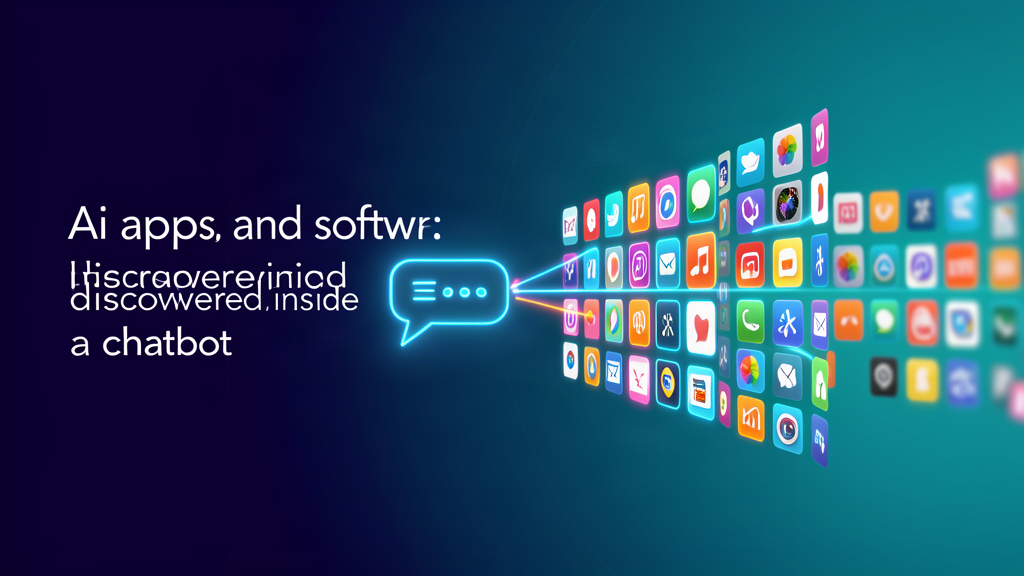
OpenAI Is Turning ChatGPT Into an App Store. Here’s How to Make Your Software Findable by AI
For years, getting people to use your software worked the same way. You built something, put it somewhere people could find it, and hoped they would come back. If you were a small app or a solo builder, you also had to compete with the App Store and Google Play deciding who got discovered and who got buried.
OpenAI just made a move that quietly changes that whole assumption. It is not just making a better chatbot. It is turning ChatGPT into the place where software gets discovered, launched, and used, by both people and agents. Software is starting to move from places you visit to capabilities any AI assistant can call.
Here is what is actually happening, what it means for anyone building software, and the practical thing you should be doing about it.
What OpenAI just announced
At Dev Day, OpenAI layered several announcements together into one bigger idea. ChatGPT now has about 1.2 billion weekly users, and OpenAI wants that to become a surface where apps work, not just a chat box.
- The chatbot is starting to suggest apps inside the flow of a conversation. When it recognizes a tool could help you finish what you are doing, it offers to connect it and use it right there.
- The plugin architecture has expanded into full extensions. Developers can build interactive panels so their software runs directly inside ChatGPT, instead of jumping out to a separate web page or native app.
- “Sign in with ChatGPT” lets people carry their identity and AI allowance into third-party apps. OpenAI named 16 launch partners, including Devin, Notion, Vercel, and OpenClaw.
- There is also an enterprise marketplace with over 30 partners.
The part to watch is not that a Notion or Figma tool can appear inside a chat window. Any plugin can do a version of that. What is different here is the distribution layer. The user is no longer choosing the app first. They describe the job, and the assistant recommends the tool. That flips which software wins, because the tool that gets recommended wins the first interaction, even if ten others can technically do the same job.
The dishonest half nobody is admitting yet
There is a big missing piece in all of this, and it matters if you are deciding where to put effort.
OpenAI has not announced a normal app-store-style billing or revenue-sharing system for developers. There is no clear version of “your extension makes $ and you get a cut.” That means right now, the discovery layer is real but the economic layer is not finished. If you build an entire business assuming the money will come, you are building on a promise.
Does that make this worth ignoring? No. It makes it worth watching honestly. The distribution shift can be real even when the monetization details are not settled yet. People who dismiss it entirely because the revenue model is unclear are making the same mistake as people who bet everything on it.
Why your software needs to be easy for an agent to find
Here is the part most people are missing, and it applies to you even if you never build a ChatGPT extension.
The direction is that software is becoming something agents can call, not just something people visit. The web is full of tools that are great for a human with a mouse, but nearly impossible for an AI agent to work with. A tool is only useful to an agent if the agent can understand what it does, know how to call it, and be given the right permissions to actually operate it.
That is starting to push every software maker to ask a different question. Instead of only “how do I get a download?” the question becomes “how do I get recommended?” And the answer is not one more landing page. It is having a workflow an AI can read, understand, and act on.
This is why I am working on using web MCP for AI Influencer Suite. MCP is the protocol that lets an outside AI assistant reach into your software as tools it can call. The goal is not to abandon the app. It is to give someone who already has their own assistant a way to reach their content workflow without learning another dashboard, and to make it the obvious thing an agent recommends.
I will be honest about where this sits. It is direction, not a finished feature. We are working toward it rather than saying it is live today. That distinction matters, because there is nothing that kills trust faster than a founder claiming software works when it is still on a drawing board. The point of sharing it is not to overpromise. It is that the question of “how do agents find and use software” is the one every small tool is about to be graded on.
What a small builder should actually do
You do not need to build a ChatGPT extension tomorrow, and you should definitely not bet your business on an unannounced revenue model. But you can start thinking in a way that keeps you ahead.
-
Understand your sticky job. The apps that win in an agent world are the ones doing something genuinely hard that a generic chatbot cannot. For a content tool, that is often identity-consistent generation, or a workflow that is already connected. If your tool is just a wrapper around a model anyone can call, there is no reason for an agent to pick you over the model.
-
Make the workflow describable. Write down exactly what a person does step by step in your software. If an AI assistant needs to drive it, that workflow has to be clear enough for the assistant to understand and replicate. A workflow an agent cannot understand is not discoverable.
-
Treat permissions as part of the product. The more your software can do, the more carefully you need to decide what an agent is allowed to do and what still needs a human. An agent with read access to a content library is a helper. An agent that can publish or spend money with no approval is a liability.
-
Build something useful first. Discovery is shifting, but bad software is still bad software. A tool nobody finds useful does not get saved by being easy for an agent to call. The agent just finds out it is not useful faster.
The honest takeaway
OpenAI is not going to replace app stores overnight, and the economic model for developers is not finished. But the direction is clear. Software is moving from being a place people visit to a set of capabilities agents can call, and that changes which tools win discovery.
You do not have to chase every new platform announcement. You do have to make sure the thing you build is something an assistant can understand, reach, and operate with the right guardrails. That, more than any single extension, is what keeps a small tool findable in the next version of the web.
If you are building content with AI and want the whole workflow in one place, AI Influencer Suite handles the connected flow, from script to image to video to captions to a content calendar. And if you want the thinking on how an agent should fit into your editing process, the walkthrough on getting an AI agent to edit video like a pro goes deeper into what the assistant should handle for you.
Call to Action
Stop posting from five disconnected subscriptions. Run your content in one connected flow, and build it in a way that is ready when people bring their own AI assistant to the job. AI Influencer Suite gives you the whole path, script to image to video to captions to a content calendar, plus 10 images and 2 videos free for life. Upgrade to Creator ($19/mo) or Pro ($39/mo) when you need more, or grab non-expiring video packs, 5 for $8, 15 for $20, 40 for $45. The software does the work; you keep the taste.
Leave a Reply